



Introduction: Why is the topic of RNP critical for business?
The Register of Unreliable Suppliers (RUS) is one of the most stringent and underestimated institutions in the system of public and corporate procurement.
For businesses, inclusion in the RNP means not just a reputational blow, but an actual blockage of access to public and quasi-public markets for up to two years.
The RNP is not a punishment or a sanction in the classical sense
It is important to understand:, but rather a special legal mechanism for filtering procurement participants. However, its consequences are often more severe than fines and penalties.
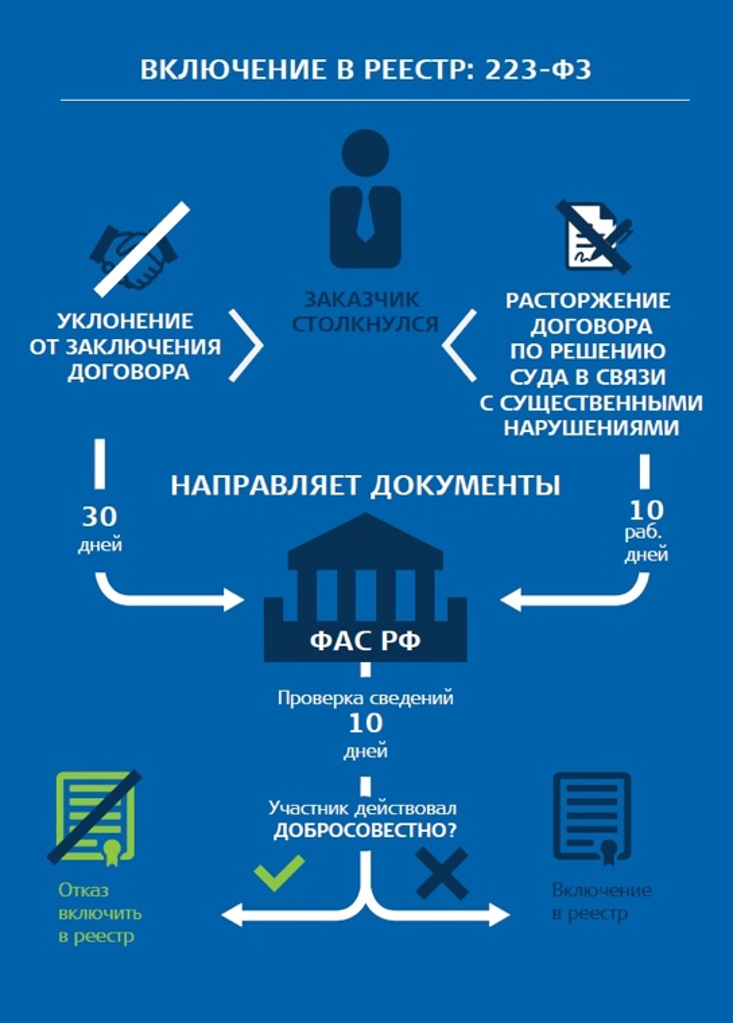
1. What is an RNP in terms of the law?
Register of Unscrupulous Suppliers (RUS) is a state information database that includes information about suppliers (legal entities and individual entrepreneurs) who have been recognized as having evaded the conclusion of a contract or have significantly violated its terms.
The RNP is conducted within the framework of:
- 44-FZ "On the Contract System..."
- 223-FZ "On Procurement by Certain Types of Legal Entities"
The registry is administered by the Federal Antimonopoly Service (FAS Russia) and its territorial bodies.
2. The legal nature of the RNP: why it is not a "blacklist"
From the point of view of the law, the RNP:
❌ is not a measure of administrative responsibility
❌ does not require proof of guilt “as in court”
✅ is a tool for public control and prevention
Key Features
The RNP is based not so much on an assessment of guilt, but rather on an assessment of the procurement participant's behavior from the perspective of good faith.
That's why:
- a formal violation may result in inclusion;
- With proper protection, even a problematic case can be turned around in favor of the business.
3. Why does the state need the RNP: the goals of the institute
Main goals of the RNP:
1. Protection of public funds
The government minimizes the risks of contract failure.
The government minimizes the risks of contract failure.
2. Filtering the procurement market
Exclusion of system intruders.
Exclusion of system intruders.
3. Disciplining suppliers
The RNP works as a preventive mechanism.
The RNP works as a preventive mechanism.
4. Formation of the integrity standard
Not only the result is evaluated, but also the behavior.
Not only the result is evaluated, but also the behavior.
4. Who gets into the RNP and why
Typical inclusion grounds:
⚠ ️ Critical:
The FAS evaluates not only the fact of a violation, but also the presence or absence of good faith actions by the supplier.
The FAS evaluates not only the fact of a violation, but also the presence or absence of good faith actions by the supplier.
5. The consequences of being included in the RNP for businesses
Inclusion in the RNP entails:
Direct consequences
- prohibition of participation in procurement under Federal Law No. 44;
- restrictions under Federal Law 223-FZ (via documentation);
- refusal of banks and guarantee organizations.
Indirect consequences
- reputational risks;
- problems with investors and partners;
- increased attention of regulatory authorities.
In fact, the RNP is a business block that is particularly sensitive to:
- construction companies;
- contractors in the fuel and energy sector and infrastructure;
- export-oriented projects with state support.
6. Why is the RNP not only a legal issue, but also a management issue?
The mistake of many companies is to consider the RNP solely as a legal task.
In practice, people end up in the RNP because of:
- management decisions;
- failures within project teams;
- lack of a GR strategy;
- ignoring regulatory logic.
👉 Therefore, effective protection is law + strategy + communication with the regulator.
7. Where can I find the RNP and how is the information used?
Information about the RNP is placed in the Unified Information System (Unified Procurement Information System) and is available in the following format::
- for customers;
- to banks;
- to counterparties;
- to regulators.
Any verification of the company before:
- participation in the tender,
- issuing a guarantee,
- a major transaction
- it starts with the RNP.
8. Practical conclusions for owners and top management
The RNP is:
- ❌ not a "technical risk"
- ❌ not a "private dispute with the customer"
- ✅ institutional business risk
And it should be managed:
- in advance;
- systemically;
- at the level of the owner and top management.
How can YANG CONSULT help you?
YANG CONSULT accompanies business:
- at the risk of being included in the RNP;
- at the stage of interaction with the Federal Antimonopoly Service;
- when challenging the regulator's decisions;
- as part of an anti-crisis GR and legal strategy.
We work strictly within the legal framework, combining:
- deep legal expertise;
- understanding the logic of the regulator;
- institutional communications.
Contacts: E-mail: info@yangconsult.com, Telegram: @info_YC
Business, government, GR, and judicial practice news on our Telegram channel: https://t.me/yangconsult