


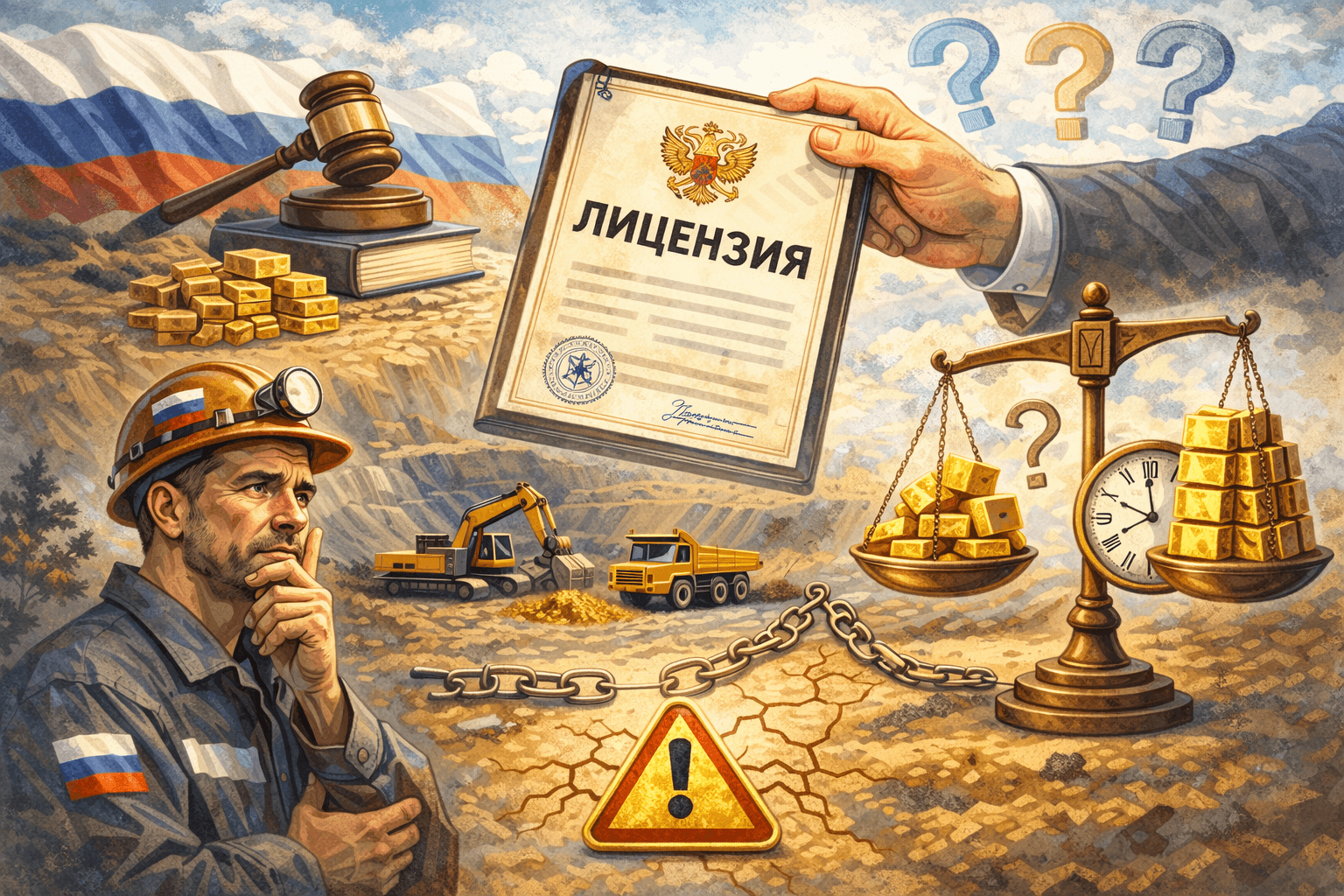
In the Russian Federation, a license to use subsoil resources for gold mining is traditionally viewed by businesses as a basic legal asset that ensures the sustainability of an investment project. However, legal and judicial practice demonstrates that a license has a distinct public law nature and does not guarantee the stability of subsoil use conditions. This article analyzes the legal essence of a gold mining license, the limits of state discretion, the key grounds for regulatory intervention, and the implications of this model for the investment and corporate strategies of gold mining companies.
1. Gold mining as an object of public interest
Gold in the Russian Federation belongs to the category of strategically important minerals, which predetermines a special legal regime. Unlike most types of business activities, gold mining involves the following:
- issues related to national financial and reserve policies;
- sustainability of regional budgets;
- environmental safety;
- social employment in remote areas.
The consequence of this is the domination of the public interest over the private interest, which fundamentally affects the legal structure of the subsoil use license.
2. Gold Mining License: Legal Nature and Restrictions
2.1. License as a Public Law Instrument
From the point of view of Russian law, a subsoil use license is not:
- right of ownership;
- absolute property right;
- guarantee of invariability of business conditions.
Legally, a license is a conditional permission from the state to carry out activities in strict compliance with the established requirements.
Table 1. Comparative Characteristics of a License and a Property Right
3. State discretion and the role of regulators
The key regulator in the field of subsoil use is the Federal Agency for Subsoil Use, which operates within the Ministry of Natural Resources and Environment of the Russian Federation.
In practice, the regulators' powers go beyond formal control and include:
- assessment of the subsoil user's "good faith";
- analysis of the actual development of the site;
- interpretation of the "materiality" of violations.
Table 2. Main points of state "consideration"
4. Judicial practice: the illusion of complete security
Despite the existence of a well-developed arbitration system, an analysis of court practice shows that courts:
- they proceed from the priority of public interest;
- recognize the broad powers of regulators;
- They rarely replace an administrative assessment with their own.
Key conclusion: the presence of a license does not exclude the state's legitimate intervention if the regulator substantiates the threat to public interests.
5. Investment implications of the licensing model
5.1. For Russian companies
- the need for constant legal and technical compliance;
- dependence on regional policy;
- high cost of errors in the early stages of a project.
5.2. For foreign investors
- limited forms of participation;
- increased requirements for the transaction structure;
- critical role of institutional support.
Table 3. The impact of legal uncertainty on investment decisions
6. License and GR: Actual Sustainability Model
Practice shows that the sustainability of a gold mining project is determined not so much by the license text, but by the quality of interaction with the government.
Diagram 1. Real project sustainability model
License
↓
Legal compliance
↓
Regional authorities
↓
Federal regulators
Ignoring the institutional level means that the license stops functioning as a business protection tool.
8. The practical significance of the findings and the role of professional support
The analysis confirms that the gold mining license in the Russian Federation operates within the framework of a public legal model, in which the sustainability of the subsoil user is determined not only by the formal compliance with the license conditions, but also by the quality of interaction with the regulatory and institutional environment.
In practice, this means that gold mining companies face a combination of risks that cannot be effectively neutralized solely through legal instruments after the fact. The following are of key importance:
- preliminary legal and regulatory audit of licenses and feasibility studies;
- support for interaction with the Federal Agency for Subsoil Use and relevant supervisory authorities;
- building a sustainable dialogue with regional authorities;
- integration of the legal, environmental, and institutional (GR) strategies of the project.
It is at this point that there is a demand for comprehensive support of gold mining projects, which combines legal expertise, judicial practice, and institutional mechanisms for business-state interaction.
The role of YANG CONSULT in supporting gold mining projects
YANG CONSULT is ready to provide comprehensive support in the implementation of projects in industries with increased regulatory and public-legal burden, including subsoil use and mining. The company's practice in the field of gold mining includes:
- legal audit of subsoil use licenses and their implementation conditions;
- support for the procedures of license renewal, re-registration, and protection;
- a strategy for protecting subsoil users in disputes with regulators and supervisory authorities;
- GR support for projects at the federal and regional levels;
- structuring investor participation, taking into account restrictions imposed by legislation on subsoil and strategic industries.
YANG CONSULT's approach is based on the understanding that in the current Russian model of subsoil use, business sustainability is formed not only in the courts, but also in the institutional framework - through systematic work with government agencies, the industry environment, and regional stakeholders.
Contact us: info@yangconsult.com
Keywords: gold mining, subsoil use, gold mining license, public law, Rosnedra, investment risks, disputes with the government.